flowchart TD
    in(( )) -->|"arrival"| S
    in -->|"vaccinated &<br/>protected"| V

    S["<b>S</b><br/>Susceptible"] -->|"infection<br/>(se.flow)"| E["<b>E</b><br/>Exposed"]
    S -->|"vaccination<br/>campaign"| V["<b>V</b><br/>Vaccine-Immune"]
    E -->|"progression<br/>(ei.rate)"| I["<b>I</b><br/>Infectious"]
    I -->|"recovery<br/>(ir.rate)"| R["<b>R</b><br/>Recovered"]

    S -->|"departure"| out1(( ))
    E -->|"departure"| out2(( ))
    I -->|"departure<br/>(elevated)"| out3(( ))
    R -->|"departure"| out4(( ))
    V -->|"departure"| out5(( ))

    style S fill:#3498db,color:#fff
    style E fill:#f39c12,color:#fff
    style I fill:#e74c3c,color:#fff
    style R fill:#27ae60,color:#fff
    style V fill:#8e44ad,color:#fff
    style in fill:none,stroke:none
    style out1 fill:none,stroke:none
    style out2 fill:none,stroke:none
    style out3 fill:none,stroke:none
    style out4 fill:none,stroke:none
    style out5 fill:none,stroke:none
SEIR Model with All-or-Nothing Vaccination
Binary vaccine immunity, herd immunity effects, and multi-route vaccination in a dynamic network
SEIR
vaccination
vital dynamics
herd immunity
intermediate
SEIR epidemic model with all-or-nothing vaccination through three delivery routes — initial coverage, ongoing campaigns, and newborn vaccination — over a dynamic network with vital dynamics.
Overview
This example demonstrates how to model an all-or-nothing (AON) vaccination intervention on an SEIR epidemic spreading over a dynamic network with vital dynamics (births and deaths). In an AON vaccine model, vaccinated individuals are either fully immune or completely unprotected — there is no partial reduction in susceptibility. This is a reasonable approximation for vaccines where the immune response is binary: either sterilizing immunity is achieved or it is not.
The key extension is a vaccination cascade operating through three routes: initial population coverage at the start of the simulation, ongoing vaccination campaigns among the existing population, and vaccination of newborns at arrival. Protected individuals are moved to a separate “V” (vaccine-immune) compartment and cannot be infected. As the V compartment grows, it reduces the pool of susceptible individuals available for transmission, creating herd immunity effects — even unvaccinated susceptibles benefit as the infectious pool shrinks.
This example introduces several important EpiModel techniques: adding custom node attributes for vaccination and protection status, implementing a separate initialization module, modeling vaccination at multiple population entry points, and comparing disease dynamics across scenarios with and without intervention. We run two scenarios — a baseline with no vaccination and a strong AON vaccination program — to illustrate how binary vaccine protection translates into population-level epidemic control.
TipDownload the Code
The standalone R scripts for this example are available for download:
- model.R — Main simulation script with network estimation, scenario comparison, and analysis
- module-fx.R — Custom module functions for vaccination, infection, progression, departures, and arrivals
Model Structure
The model extends the standard SEIR framework with a vaccine-immune compartment (V) and vital dynamics:
| Compartment | Label | Description |
|---|---|---|
| Susceptible | S | Not infected; at risk of infection |
| Exposed | E | Infected but not yet infectious (latent period) |
| Infectious | I | Infected and capable of transmitting |
| Recovered | R | Recovered with permanent natural immunity |
| Vaccine-Immune | V | Protected by AON vaccination; completely immune |
All-or-Nothing Vaccination Mechanism
The AON vaccine works in two steps. First, an individual receives the vaccine (tracked by the vaccination attribute, which records the route: “initial”, “progress”, or “arrival”). Second, a vaccinated susceptible individual has a probability of receiving protection. If protected, they move to status = "v" and become completely immune. If not protected, they remain susceptible with protection = "none" and cannot be re-vaccinated.
Key assumptions of this model:
- Binary immunity: Protected individuals have 100% immunity (cannot be infected). Unprotected individuals receive 0% benefit.
- One-shot vaccination: Individuals can only be vaccinated once. Those who fail to receive protection on their first vaccination do not get a second chance.
- No waning: Vaccine immunity is permanent. Protected individuals remain in V indefinitely.
Vaccination Routes
| Route | When | Rate Parameters |
|---|---|---|
| Initialization | Timestep 2 only | vaccination.rate.initialization, protection.rate.initialization |
| Progression | Every timestep | vaccination.rate.progression, protection.rate.progression |
| Arrivals | At birth | vaccination.rate.arrivals, protection.rate.arrivals |
The effective per-route protection rate is the product of the two rates. For example, with vaccination.rate.arrivals = 0.6 and protection.rate.arrivals = 0.8, 48% of newborns become vaccine-immune.
Setup
library(EpiModel)We set simulation parameters for the interactive session. Five simulations over 500 weekly timesteps provide enough replication and duration to observe the epidemic trajectory and herd immunity effects.
nsims <- 5
ncores <- 5
nsteps <- 500
Custom Modules
This model uses five custom module functions. The vaccine attribute initialization module runs once to set up vaccination tracking, the infection module handles S-to-E transmission, the progression module moves individuals through E-to-I and I-to-R, the departure module simulates mortality, and the arrival module handles births and ongoing vaccination.
Vaccine Attribute Initialization (init_vaccine_attrs)
This module runs once at the first module call to initialize the vaccination and protection attributes for all nodes. It checks whether attributes have already been set using override.null.error and stochastically vaccinates the initial population with the initialization rates. Only vaccinated susceptible individuals can receive protection — vaccinated nodes that are already infected gain no benefit.
init_vaccine_attrs <- function(dat, at) {

1  if (is.null(get_attr(dat, "vaccination", override.null.error = TRUE))) {

    ## Attributes ##
    active <- get_attr(dat, "active")
    n <- sum(active == 1)
    status <- get_attr(dat, "status")

    ## Parameters ##
    vaccination.rate.init <- get_param(dat, "vaccination.rate.initialization")
    protection.rate.init <- get_param(dat, "protection.rate.initialization")

    ## Initialize vectors (NA = unvaccinated/unprotected) ##
    vaccination <- rep(NA, n)
    protection <- rep(NA, n)

    ## Stochastic vaccination of initial population ##
    idsEligVacInit <- which(active == 1)
    vecVacInit <- rbinom(length(idsEligVacInit), 1, vaccination.rate.init)
    idsVacInit <- idsEligVacInit[which(vecVacInit == 1)]
    vaccination[idsVacInit] <- "initial"

    ## Stochastic protection among vaccinated susceptibles ##
2    idsEligProtInit <- which(vaccination == "initial" & status == "s")
    vecProtInit <- rbinom(length(idsEligProtInit), 1, protection.rate.init)
    idsProtInit <- idsEligProtInit[which(vecProtInit == 1)]
    idsNoProtInit <- setdiff(idsVacInit, idsProtInit)
    protection[idsProtInit] <- "initial"
3    protection[idsNoProtInit] <- "none"

    ## Write out attributes ##
    dat <- set_attr(dat, "vaccination", vaccination)
    dat <- set_attr(dat, "protection", protection)
  }

  return(dat)
}- 1
-
override.null.error = TRUEreturnsNULLinstead of an error if the attribute does not exist yet, allowing this module to detect its first call and run initialization exactly once. - 2
- Only vaccinated susceptible nodes are eligible for protection. Individuals who are already infected at initialization gain no benefit from vaccination.
- 3
-
Vaccinated but unprotected individuals receive
protection = "none", which permanently marks them as ineligible for future vaccination — this enforces the one-shot assumption.
Infection Module (infect)
This module simulates S-to-E transmission along discordant edges in the network. The critical feature for the vaccination model is that protected individuals (status = "v") are automatically excluded from the susceptible pool by discord_edgelist(), which only considers nodes with status = "s" as susceptible. No special vaccination logic is needed in the infection module itself.
infect <- function(dat, at) {

  ## Attributes ##
  active <- get_attr(dat, "active")
  status <- get_attr(dat, "status")
  infTime <- get_attr(dat, "infTime")

  ## Parameters ##
  inf.prob <- get_param(dat, "inf.prob")
  act.rate <- get_param(dat, "act.rate")

  ## Find infected nodes ##
  idsInf <- which(active == 1 & status == "i")
  nActive <- sum(active == 1)
  nElig <- length(idsInf)

  ## Initialize incidence counter ##
  nInf <- 0

  ## Transmission process ##
  if (nElig > 0 && nElig < nActive) {

1    del <- discord_edgelist(dat, at)

    if (!(is.null(del)) && nrow(del) > 0) {

      del$transProb <- inf.prob
      del$actRate <- act.rate
2      del$finalProb <- 1 - (1 - del$transProb)^del$actRate

      transmit <- rbinom(nrow(del), 1, del$finalProb)
      del <- del[which(transmit == 1), ]

      idsNewInf <- unique(del$sus)
      nInf <- length(idsNewInf)

      if (nInf > 0) {
3        status[idsNewInf] <- "e"
        dat <- set_attr(dat, "status", status)
        infTime[idsNewInf] <- at
        dat <- set_attr(dat, "infTime", infTime)
      }
    }
  }

  ## Summary statistics ##
  dat <- set_epi(dat, "se.flow", at, nInf)

  dat <- set_epi(dat, "s.num", at, sum(active == 1 & status == "s"))
  dat <- set_epi(dat, "e.num", at, sum(active == 1 & status == "e"))
  dat <- set_epi(dat, "i.num", at, sum(active == 1 & status == "i"))
  dat <- set_epi(dat, "r.num", at, sum(active == 1 & status == "r"))
4  dat <- set_epi(dat, "v.num", at, sum(active == 1 & status == "v"))

  return(dat)
}- 1
-
discord_edgelist()returns edges connecting infectious and susceptible nodes. Vaccine-immune nodes (status = "v") are not considered susceptible, so they never appear on this list — this is the mechanism by which AON vaccination prevents infection. - 2
- The per-timestep transmission probability accounts for multiple acts per partnership: \(P = 1 - (1 - p)^a\) where \(p\) is the per-act probability and \(a\) is the act rate.
- 3
- Newly infected individuals enter the exposed (E) compartment, not directly infectious — they must progress through the latent period before they can transmit.
- 4
- The V compartment count is tracked alongside the standard SEIR compartments so it can be plotted and analyzed.
Disease Progression Module (progress)
This module handles E-to-I progression (exposed to infectious) and I-to-R recovery (infectious to recovered). There is no R-to-S transition — this is an SEIR model with permanent natural immunity after recovery.
progress <- function(dat, at) {

  ## Attributes ##
  active <- get_attr(dat, "active")
  status <- get_attr(dat, "status")

  ## Parameters ##
  ei.rate <- get_param(dat, "ei.rate")
  ir.rate <- get_param(dat, "ir.rate")

  ## E -> I (exposed to infectious) ##
  nProg <- 0
  idsEligProg <- which(active == 1 & status == "e")
  nEligProg <- length(idsEligProg)

  if (nEligProg > 0) {
1    vecProg <- which(rbinom(nEligProg, 1, ei.rate) == 1)
    if (length(vecProg) > 0) {
      idsProg <- idsEligProg[vecProg]
      nProg <- length(idsProg)
      status[idsProg] <- "i"
    }
  }

  ## I -> R (infectious to recovered) ##
  nRec <- 0
  idsEligRec <- which(active == 1 & status == "i")
  nEligRec <- length(idsEligRec)

  if (nEligRec > 0) {
    vecRec <- which(rbinom(nEligRec, 1, ir.rate) == 1)
    if (length(vecRec) > 0) {
      idsRec <- idsEligRec[vecRec]
      nRec <- length(idsRec)
      status[idsRec] <- "r"
    }
  }

  ## Write out updated status ##
  dat <- set_attr(dat, "status", status)

  ## Summary statistics ##
  dat <- set_epi(dat, "ei.flow", at, nProg)
  dat <- set_epi(dat, "ir.flow", at, nRec)

  return(dat)
}- 1
-
Each exposed individual faces an independent Bernoulli trial with probability
ei.rateat each timestep. Withei.rate = 0.05, the mean latent period is \(1/0.05 = 20\) weeks. The same geometric waiting time applies to I-to-R recovery.
Departure Module (dfunc)
This module simulates mortality (departures) with disease-induced excess. All active nodes face a baseline departure.rate per timestep, while infected individuals (status “i”) have their rate multiplied by departure.disease.mult, representing excess disease-induced mortality.
dfunc <- function(dat, at) {

  ## Attributes ##
  active <- get_attr(dat, "active")
  status <- get_attr(dat, "status")
  exitTime <- get_attr(dat, "exitTime")

  ## Parameters ##
  departure.rate <- get_param(dat, "departure.rate")
  dep.rates <- rep(departure.rate, length(active))
  dep.dis.mult <- get_param(dat, "departure.disease.mult")

  ## Determine eligible (alive) nodes ##
  idsElig <- which(active == 1)
  nElig <- length(idsElig)
  nDeaths <- 0

  if (nElig > 0) {

    dep_rates_of_elig <- dep.rates[idsElig]

    idsElig.inf <- which(status[idsElig] == "i")
1    dep_rates_of_elig[idsElig.inf] <- dep.rates[idsElig.inf] * dep.dis.mult

    ## Stochastic departure process ##
    vecDeaths <- which(rbinom(nElig, 1, dep_rates_of_elig) == 1)
    idsDeaths <- idsElig[vecDeaths]
    nDeaths <- length(idsDeaths)

    if (nDeaths > 0) {
      active[idsDeaths] <- 0
2      exitTime[idsDeaths] <- at
    }
  }

  ## Write out updated attributes ##
  dat <- set_attr(dat, "active", active)
  dat <- set_attr(dat, "exitTime", exitTime)

  ## Summary statistics ##
  dat <- set_epi(dat, "d.flow", at, nDeaths)

  return(dat)
}- 1
-
Infected individuals face
departure.rate * departure.disease.mult(2x baseline), representing excess disease-induced mortality. This creates selective pressure that removes infectious individuals faster than other compartments. - 2
-
Setting
exitTimerecords when each node departs, which EpiModel uses for network bookkeeping and summary statistics.
Arrival Module (afunc)
This is the most complex module, handling both births (new node arrivals) and ongoing vaccination. Two vaccination routes operate each timestep: progression (campaigns among existing unvaccinated nodes) and arrivals (newborn vaccination). After all vaccination processing, any susceptible node with vaccine protection is moved to status = "v".
afunc <- function(dat, at) {

  ## Attributes ##
  active <- get_attr(dat, "active")
  status <- get_attr(dat, "status")
  infTime <- get_attr(dat, "infTime")

  ## Parameters ##
  nActive <- sum(active == 1)
  nTotal <- length(active)
  a.rate <- get_param(dat, "arrival.rate")
  vaccination.rate.arrivals <- get_param(dat, "vaccination.rate.arrivals")
  protection.rate.arrivals <- get_param(dat, "protection.rate.arrivals")
  vaccination.rate.progression <- get_param(dat, "vaccination.rate.progression")
  protection.rate.progression <- get_param(dat, "protection.rate.progression")

  ## Initialize flow counters ##
  nVax.prog <- 0
  nPrt.prog <- 0
  nVax.arrival <- 0
  nPrt.arrival <- 0

  vaccination <- get_attr(dat, "vaccination")
  protection <- get_attr(dat, "protection")

  ## --- VACCINATION PROGRESSION --- ##
1  idsEligVacProg <- which(is.na(vaccination) & active == 1)
  vecVacProg <- rbinom(length(idsEligVacProg), 1, vaccination.rate.progression)
  idsVacProg <- idsEligVacProg[which(vecVacProg == 1)]
  vaccination[idsVacProg] <- "progress"

  idsEligProtProg <- which(vaccination == "progress" & is.na(protection) & status == "s")
  vecProtProg <- rbinom(length(idsEligProtProg), 1, protection.rate.progression)
  idsProtProg <- idsEligProtProg[which(vecProtProg == 1)]
  idsNoProtProg <- setdiff(idsVacProg, idsProtProg)
  protection[idsProtProg] <- "progress"
  protection[idsNoProtProg] <- "none"

  nVax.prog <- length(idsVacProg)
  nPrt.prog <- length(idsProtProg)

  ## --- ARRIVAL PROCESS --- ##
  nArrivalsExp <- nActive * a.rate
2  nArrivals <- rpois(1, nArrivalsExp)

  if (nArrivals > 0) {
3    dat <- append_core_attr(dat, at, nArrivals)

    newNodes <- (nTotal + 1):(nTotal + nArrivals)
    status <- c(status, rep("s", nArrivals))
    infTime <- c(infTime, rep(NA, nArrivals))
    vaccination <- c(vaccination, rep(NA, nArrivals))
    protection <- c(protection, rep(NA, nArrivals))

    # Vaccinate new arrivals
    vaccinatedNewArrivals <- rbinom(nArrivals, 1, vaccination.rate.arrivals)
    vaccination[newNodes] <- ifelse(vaccinatedNewArrivals == 1, "arrival", NA)
    nVax.arrival <- sum(vaccinatedNewArrivals == 1)

    # Confer protection to vaccinated susceptible arrivals
    idsEligProtArrival <- which(
      vaccination == "arrival" & status == "s" & is.na(protection)
    )
    vecProtArrival <- rbinom(length(idsEligProtArrival), 1, protection.rate.arrivals)
    idsProtArrival <- idsEligProtArrival[which(vecProtArrival == 1)]
    idsNoProtArrival <- idsEligProtArrival[which(vecProtArrival == 0)]
    protection[idsProtArrival] <- "arrival"
    protection[idsNoProtArrival] <- "none"
    nPrt.arrival <- sum(vecProtArrival == 1)
  }

  ## --- UPDATE STATUS: protected susceptibles -> vaccine-immune --- ##
  active <- get_attr(dat, "active")
  statusV <- which(
    status == "s" & protection %in% c("initial", "progress", "arrival") &
      active == 1
  )
4  status[statusV] <- "v"

  ## Write out updated attributes ##
  dat <- set_attr(dat, "status", status)
  dat <- set_attr(dat, "vaccination", vaccination)
  dat <- set_attr(dat, "protection", protection)
  dat <- set_attr(dat, "infTime", infTime)

  ## Summary statistics ##
  dat <- set_epi(dat, "a.flow", at, nArrivals)
  dat <- set_epi(dat, "vac.flow", at, nVax.prog + nVax.arrival)
  dat <- set_epi(dat, "prt.flow", at, nPrt.prog + nPrt.arrival)
  dat <- set_epi(dat, "vac.num", at,
                 sum(active == 1 & vaccination %in%
                       c("initial", "progress", "arrival"), na.rm = TRUE))
  dat <- set_epi(dat, "prt.num", at,
                 sum(active == 1 & protection %in%
                       c("initial", "progress", "arrival"), na.rm = TRUE))

  return(dat)
}- 1
-
Only unvaccinated (
is.na(vaccination)) active nodes are eligible for campaign vaccination. This enforces the one-shot rule — previously vaccinated individuals (whether protected or not) cannot be re-vaccinated. - 2
-
The number of arrivals is drawn from a Poisson distribution with mean
nActive * arrival.rate, producing stochastic variation in births each week. - 3
-
append_core_attr()is the EpiModel function for adding new nodes to the simulation, initializing their core attributes (active status, unique ID, entry time). - 4
-
This is the all-or-nothing mechanism: any susceptible node with vaccine protection is moved to
status = "v"(complete immunity). After this step,discord_edgelist()in the infection module will never consider these nodes as susceptible.
Network Model
We initialize a 500-node network with a simple edges-only formation model targeting a mean degree of 0.8 (200 edges). The dissolution coefficient is adjusted for population turnover using the departure rate.
n <- 500
nw <- network_initialize(n)
formation <- ~edges
mean_degree <- 0.8
n_edges <- mean_degree * (n / 2)
target.stats <- c(n_edges)The departure rate of 0.008 per week corresponds to a mean lifespan of approximately 2.4 years. This is high relative to real human populations but creates visible demographic turnover within the simulation window, demonstrating how vital dynamics interact with vaccination and disease transmission. The dissolution coefficient accounts for this turnover so that the target partnership duration of 50 weeks is maintained in the open population.
departure_rate <- 0.008

coef.diss <- dissolution_coefs(
  dissolution = ~offset(edges),
  duration = 50,
1  d.rate = departure_rate
)
coef.diss- 1
-
Including
d.rateadjusts the dissolution coefficient for population turnover. Without this correction, partnerships would dissolve faster than intended because node departures also end partnerships.
Dissolution Coefficients
=======================
Dissolution Model: ~offset(edges)
Target Statistics: 50
Crude Coefficient: 3.89182
Mortality/Exit Rate: 0.008
Adjusted Coefficient: 5.485385
Network Estimation
est <- netest(nw, formation, target.stats, coef.diss)Network Diagnostics
We simulate from the fitted network model to verify it reproduces the target statistics. The diagnostics check that the mean number of edges remains near 200 and that the degree distribution is stable.
dx <- netdx(est, nsims = nsims, ncores = ncores, nsteps = nsteps,
            nwstats.formula = ~edges + isolates + degree(0:5))
Network Diagnostics
-----------------------
- Simulating 5 networks
- Calculating formation statisticsprint(dx)EpiModel Network Diagnostics
=======================
Diagnostic Method: Dynamic
Simulations: 5
Time Steps per Sim: 500
Formation Diagnostics
-----------------------
Target Sim Mean Pct Diff Sim SE Z Score SD(Sim Means) SD(Statistic)
edges 200 200.329 0.165 2.071 0.159 8.526 14.222
isolates NA 225.010 NA 1.834 NA 6.958 13.982
degree0 NA 225.010 NA 1.834 NA 6.958 13.982
degree1 NA 179.321 NA 1.271 NA 1.797 11.155
degree2 NA 71.254 NA 0.876 NA 3.421 8.413
degree3 NA 19.560 NA 0.465 NA 1.885 4.706
degree4 NA 4.220 NA 0.199 NA 1.195 2.324
degree5 NA 0.554 NA 0.061 NA 0.108 0.764
Duration Diagnostics
-----------------------
Target Sim Mean Pct Diff Sim SE Z Score SD(Sim Means) SD(Statistic)
edges 50 50.182 0.364 0.601 0.303 2.265 3.808
Dissolution Diagnostics
-----------------------
Target Sim Mean Pct Diff Sim SE Z Score SD(Sim Means) SD(Statistic)
edges 0.02 0.02 -0.244 0 -0.246 0.001 0.01plot(dx)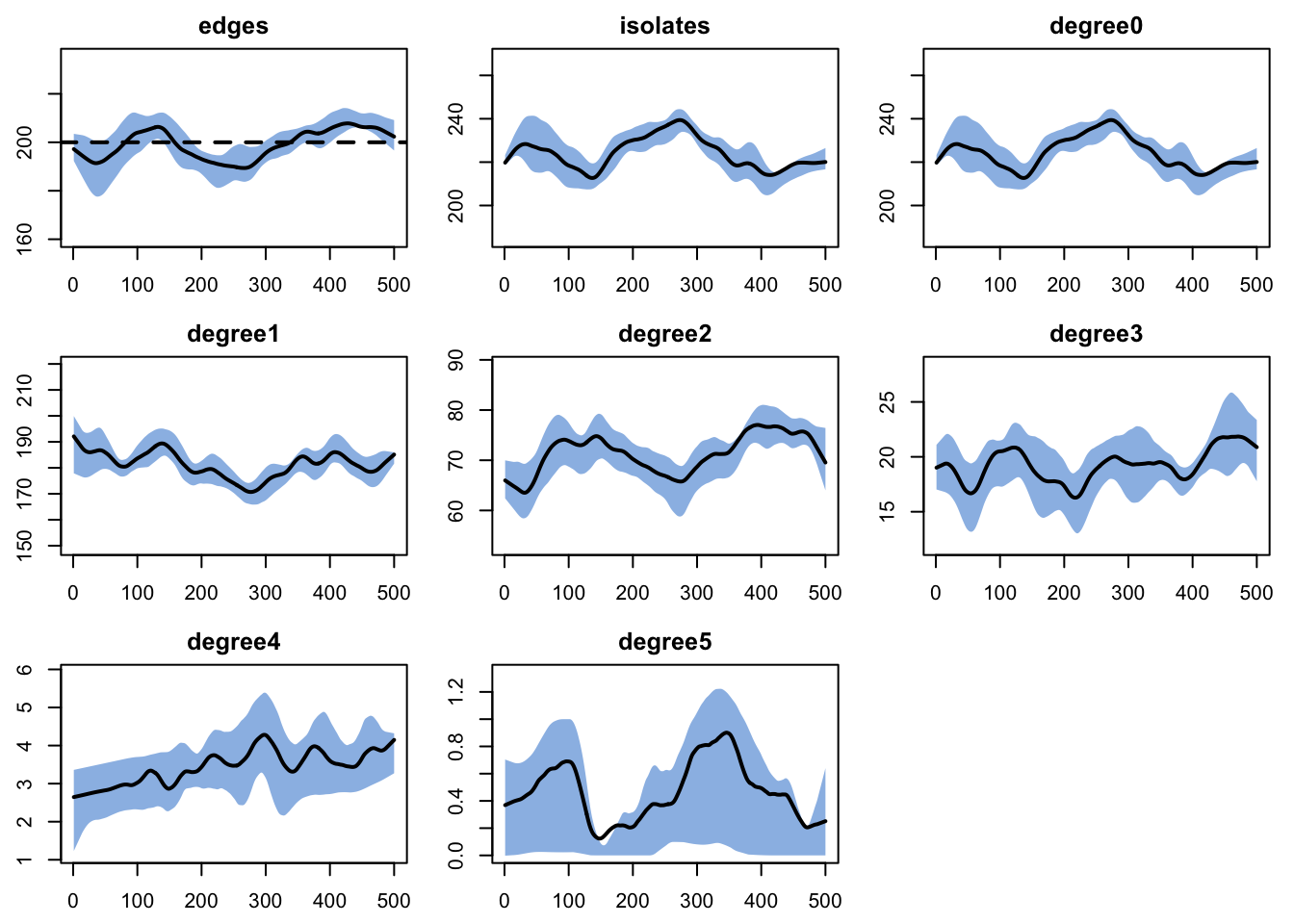
Epidemic Simulation
Initial Conditions
We seed the epidemic with 20 infected nodes (4% initial prevalence). All other nodes start as susceptible; the initialization module will then apply initial vaccination coverage.
init <- init.net(i.num = 20)Control Settings
The control settings register the custom modules and specify the module execution order. Setting resimulate.network = TRUE is required because the population size changes with vital dynamics, so the network must be resimulated each timestep rather than replayed from a pre-simulated sequence.
control <- control.net(
1  type = NULL,
  nsims = nsims,
  ncores = ncores,
  nsteps = nsteps,
  initAttr.FUN = init_vaccine_attrs,
  infection.FUN = infect,
  progress.FUN = progress,
  departures.FUN = dfunc,
  arrivals.FUN = afunc,
2  resimulate.network = TRUE,
  verbose = FALSE,
  module.order = c("resim_nets.FUN", "initAttr.FUN",
                   "departures.FUN", "arrivals.FUN",
                   "infection.FUN", "progress.FUN",
3                   "prevalence.FUN")
)- 1
-
type = NULLtells EpiModel that all disease modules are user-defined, disabling the built-in SIS/SIR models. - 2
-
resimulate.network = TRUEresimulates the network each timestep to accommodate the changing population size from births and deaths. - 3
-
Departures and arrivals are placed before infection so the network reflects the current population when transmission is simulated. The
initAttrmodule runs early but only operates at the first timestep.
Scenario 1: No Vaccination (SEIR Baseline)
In the baseline scenario, all vaccination rates are set to zero. The epidemic spreads through the population limited only by natural immunity (recovery to R) and demographic turnover. New susceptible arrivals continuously enter, potentially fueling recurrent transmission waves.
param_novax <- param.net(
  inf.prob = 0.5, act.rate = 1,
  ei.rate = 0.05, ir.rate = 0.05,
  departure.rate = departure_rate,
  departure.disease.mult = 2,
  arrival.rate = 0.008,
  vaccination.rate.initialization = 0,
  protection.rate.initialization = 0,
  vaccination.rate.progression = 0,
  protection.rate.progression = 0,
  vaccination.rate.arrivals = 0,
  protection.rate.arrivals = 0
)

sim_novax <- netsim(est, param_novax, init, control)
print(sim_novax)
EpiModel Simulation
=======================
Model class: netsim
Simulation Summary
-----------------------
Model type:
No. simulations: 5
No. time steps: 500
No. NW groups: 1
Fixed Parameters
---------------------------
inf.prob = 0.5
act.rate = 1
ei.rate = 0.05
ir.rate = 0.05
departure.rate = 0.008
departure.disease.mult = 2
arrival.rate = 0.008
vaccination.rate.initialization = 0
protection.rate.initialization = 0
vaccination.rate.progression = 0
protection.rate.progression = 0
vaccination.rate.arrivals = 0
protection.rate.arrivals = 0
groups = 1
Model Functions
-----------------------
initialize.FUN
resim_nets.FUN
summary_nets.FUN
infection.FUN
departures.FUN
arrivals.FUN
nwupdate.FUN
prevalence.FUN
verbose.FUN
initAttr.FUN
progress.FUN
Model Output
-----------------------
Variables: s.num i.num num d.flow a.flow vac.flow prt.flow
vac.num prt.num se.flow e.num r.num v.num ei.flow ir.flow
Networks: sim1 ... sim5
Transmissions: sim1 ... sim5
Formation Statistics
-----------------------
Target Sim Mean Pct Diff Sim SE Z Score SD(Sim Means) SD(Statistic)
edges 200 214.6 7.3 Inf 0 19.604 19.604
Duration Statistics
-----------------------
Target Sim Mean Pct Diff Sim SE Z Score SD(Sim Means) SD(Statistic)
edges 50 121.691 143.382 15.984 4.485 3.722 40.768
Dissolution Statistics
-----------------------
Target Sim Mean Pct Diff Sim SE Z Score SD(Sim Means) SD(Statistic)
edges 0.02 0.004 -79.132 0 -281.62 0 0.003Scenario 2: Strong AON Vaccination Program
The vaccination scenario uses aggressive rates: 60% of newborns are vaccinated with an 80% protection rate (yielding 48% effective newborn protection), and 5% of unvaccinated individuals receive campaign vaccination each week (also with 80% protection). Over time, the V compartment grows, reducing the susceptible pool and creating herd immunity effects.
param_vax <- param.net(
  inf.prob = 0.5, act.rate = 1,
  ei.rate = 0.05, ir.rate = 0.05,
  departure.rate = departure_rate,
  departure.disease.mult = 2,
  arrival.rate = 0.008,
  vaccination.rate.initialization = 0.05,
  protection.rate.initialization = 0.8,
  vaccination.rate.progression = 0.05,
  protection.rate.progression = 0.8,
  vaccination.rate.arrivals = 0.6,
  protection.rate.arrivals = 0.8
)

sim_vax <- netsim(est, param_vax, init, control)
print(sim_vax)
EpiModel Simulation
=======================
Model class: netsim
Simulation Summary
-----------------------
Model type:
No. simulations: 5
No. time steps: 500
No. NW groups: 1
Fixed Parameters
---------------------------
inf.prob = 0.5
act.rate = 1
ei.rate = 0.05
ir.rate = 0.05
departure.rate = 0.008
departure.disease.mult = 2
arrival.rate = 0.008
vaccination.rate.initialization = 0.05
protection.rate.initialization = 0.8
vaccination.rate.progression = 0.05
protection.rate.progression = 0.8
vaccination.rate.arrivals = 0.6
protection.rate.arrivals = 0.8
groups = 1
Model Functions
-----------------------
initialize.FUN
resim_nets.FUN
summary_nets.FUN
infection.FUN
departures.FUN
arrivals.FUN
nwupdate.FUN
prevalence.FUN
verbose.FUN
initAttr.FUN
progress.FUN
Model Output
-----------------------
Variables: s.num i.num num d.flow a.flow vac.flow prt.flow
vac.num prt.num se.flow e.num r.num v.num ei.flow ir.flow
Networks: sim1 ... sim5
Transmissions: sim1 ... sim5
Formation Statistics
-----------------------
Target Sim Mean Pct Diff Sim SE Z Score SD(Sim Means) SD(Statistic)
edges 200 196.4 -1.8 Inf 0 13.409 13.409
Duration Statistics
-----------------------
Target Sim Mean Pct Diff Sim SE Z Score SD(Sim Means) SD(Statistic)
edges 50 117.697 135.394 14.791 4.577 2.71 38.757
Dissolution Statistics
-----------------------
Target Sim Mean Pct Diff Sim SE Z Score SD(Sim Means) SD(Statistic)
edges 0.02 0.004 -79.291 0 -278.643 0 0.003Analysis
Prevalence Comparison
We compute prevalence as the proportion of the population that is infectious and compare the two scenarios side by side. This is the headline result — vaccination dramatically reduces disease prevalence through herd immunity effects.
sim_novax <- mutate_epi(sim_novax, prev = i.num / num)
sim_vax <- mutate_epi(sim_vax, prev = i.num / num)par(mar = c(3, 3, 2, 1), mgp = c(2, 1, 0))
plot(sim_novax, y = "prev",
main = "Prevalence: No Vaccination vs. AON Vaccination",
ylab = "Prevalence (I / N)", xlab = "Week",
mean.col = "firebrick", mean.lwd = 2, mean.smooth = TRUE,
qnts.col = "firebrick", qnts.alpha = 0.2, qnts.smooth = TRUE,
legend = FALSE, ylim = ylim_epi(list(sim_novax, sim_vax), "prev"))
plot(sim_vax, y = "prev",
mean.col = "seagreen", mean.lwd = 2, mean.smooth = TRUE,
qnts.col = "seagreen", qnts.alpha = 0.2, qnts.smooth = TRUE,
legend = FALSE, add = TRUE)
legend("topright",
legend = c("No Vaccination", "Strong AON Vaccination"),
col = c("firebrick", "seagreen"), lwd = 2, bty = "n")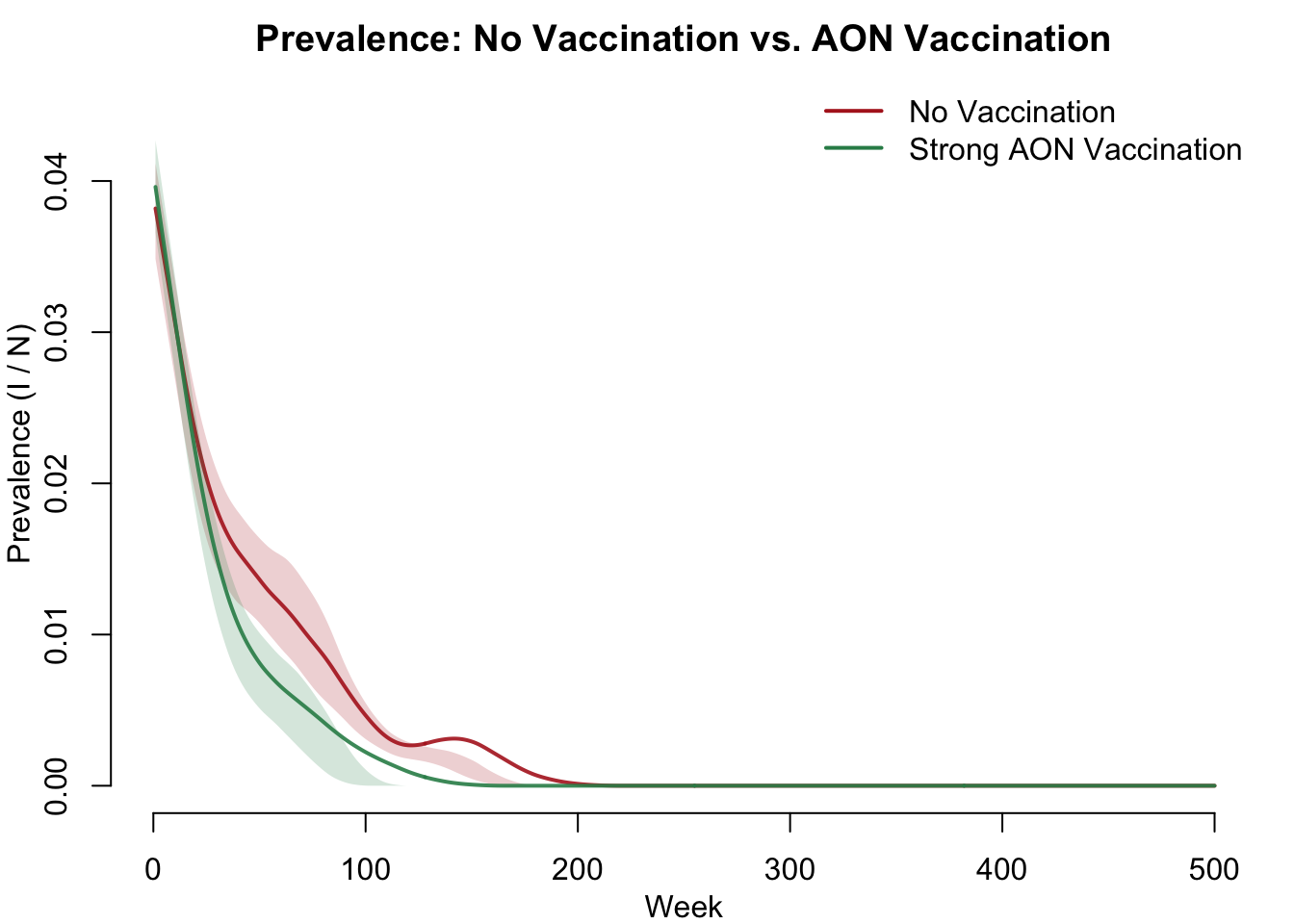
SEIR Compartments (No Vaccination)
Without vaccination, the SEIR dynamics show the classic epidemic curve. Susceptibles decline as exposed and infectious counts rise, then recovery transfers individuals to R. Vital dynamics continuously introduce new susceptibles via births, which can fuel recurrent transmission waves.
par(mfrow = c(2, 2), mar = c(3, 3, 2, 1), mgp = c(2, 1, 0))
plot(sim_novax, y = "s.num",
     main = "Susceptible (S)", ylab = "Count", xlab = "Week",
     mean.col = "steelblue", mean.lwd = 2, mean.smooth = TRUE,
     qnts.col = "steelblue", qnts.alpha = 0.2, qnts.smooth = TRUE,
     legend = FALSE)
plot(sim_novax, y = "e.num",
     main = "Exposed (E)", ylab = "Count", xlab = "Week",
     mean.col = "#f39c12", mean.lwd = 2, mean.smooth = TRUE,
     qnts.col = "#f39c12", qnts.alpha = 0.2, qnts.smooth = TRUE,
     legend = FALSE)
plot(sim_novax, y = "i.num",
     main = "Infectious (I)", ylab = "Count", xlab = "Week",
     mean.col = "firebrick", mean.lwd = 2, mean.smooth = TRUE,
     qnts.col = "firebrick", qnts.alpha = 0.2, qnts.smooth = TRUE,
     legend = FALSE)
plot(sim_novax, y = "r.num",
     main = "Recovered (R)", ylab = "Count", xlab = "Week",
     mean.col = "seagreen", mean.lwd = 2, mean.smooth = TRUE,
     qnts.col = "seagreen", qnts.alpha = 0.2, qnts.smooth = TRUE,
     legend = FALSE)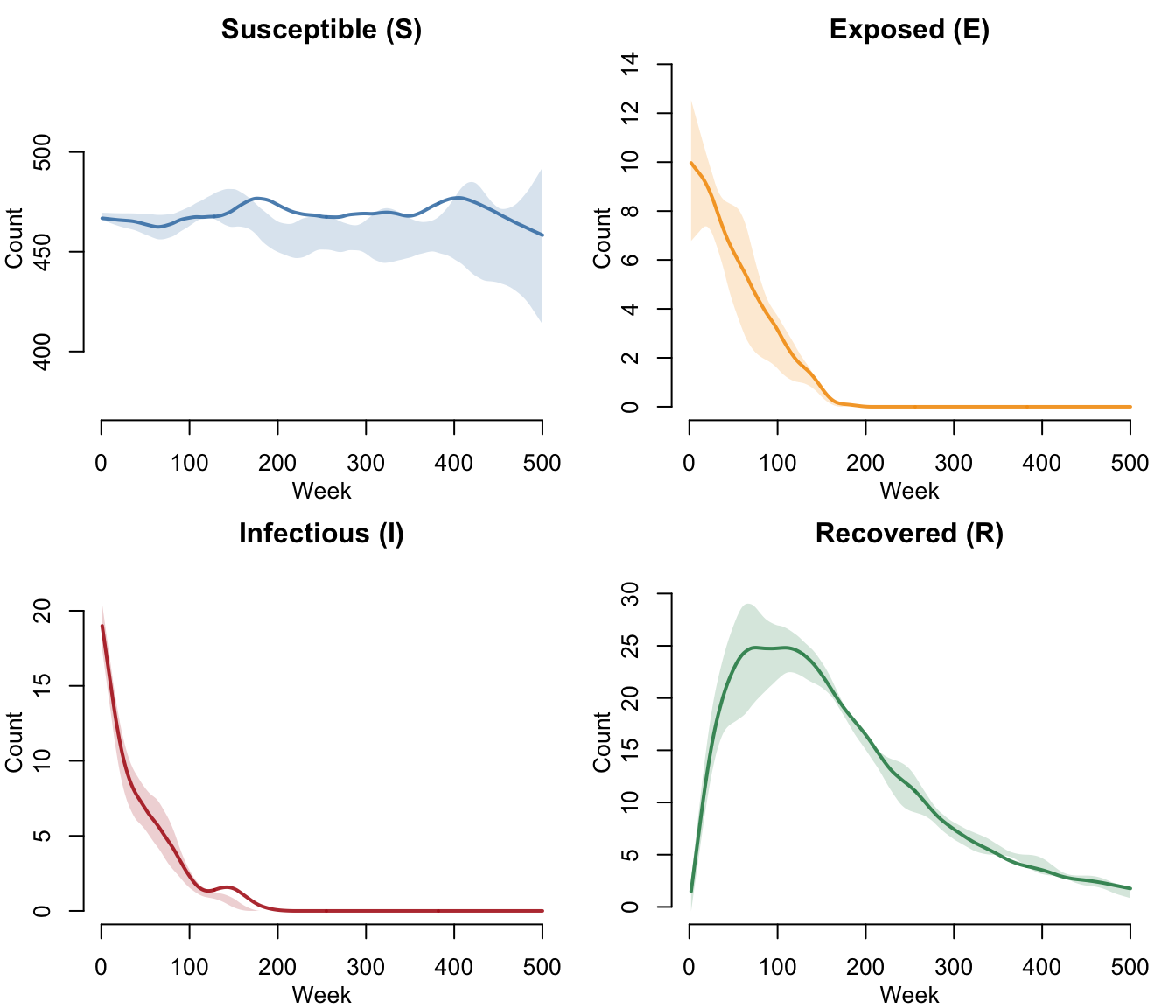
SEIR-V Compartments (With Vaccination)
With vaccination, the V (vaccine-immune) compartment absorbs a growing fraction of the population. This reduces the effective susceptible pool, lowering the reproductive number and suppressing the epidemic. The five-panel layout shows all compartments including the vaccine-immune class.
par(mfrow = c(2, 3), mar = c(3, 3, 2, 1), mgp = c(2, 1, 0))
plot(sim_vax, y = "s.num",
     main = "Susceptible (S)", ylab = "Count", xlab = "Week",
     mean.col = "steelblue", mean.lwd = 2, mean.smooth = TRUE,
     qnts.col = "steelblue", qnts.alpha = 0.2, qnts.smooth = TRUE,
     legend = FALSE)
plot(sim_vax, y = "e.num",
     main = "Exposed (E)", ylab = "Count", xlab = "Week",
     mean.col = "#f39c12", mean.lwd = 2, mean.smooth = TRUE,
     qnts.col = "#f39c12", qnts.alpha = 0.2, qnts.smooth = TRUE,
     legend = FALSE)
plot(sim_vax, y = "i.num",
     main = "Infectious (I)", ylab = "Count", xlab = "Week",
     mean.col = "firebrick", mean.lwd = 2, mean.smooth = TRUE,
     qnts.col = "firebrick", qnts.alpha = 0.2, qnts.smooth = TRUE,
     legend = FALSE)
plot(sim_vax, y = "r.num",
     main = "Recovered (R)", ylab = "Count", xlab = "Week",
     mean.col = "seagreen", mean.lwd = 2, mean.smooth = TRUE,
     qnts.col = "seagreen", qnts.alpha = 0.2, qnts.smooth = TRUE,
     legend = FALSE)
plot(sim_vax, y = "v.num",
     main = "Vaccine-Immune (V)", ylab = "Count", xlab = "Week",
     mean.col = "#8e44ad", mean.lwd = 2, mean.smooth = TRUE,
     qnts.col = "#8e44ad", qnts.alpha = 0.2, qnts.smooth = TRUE,
     legend = FALSE)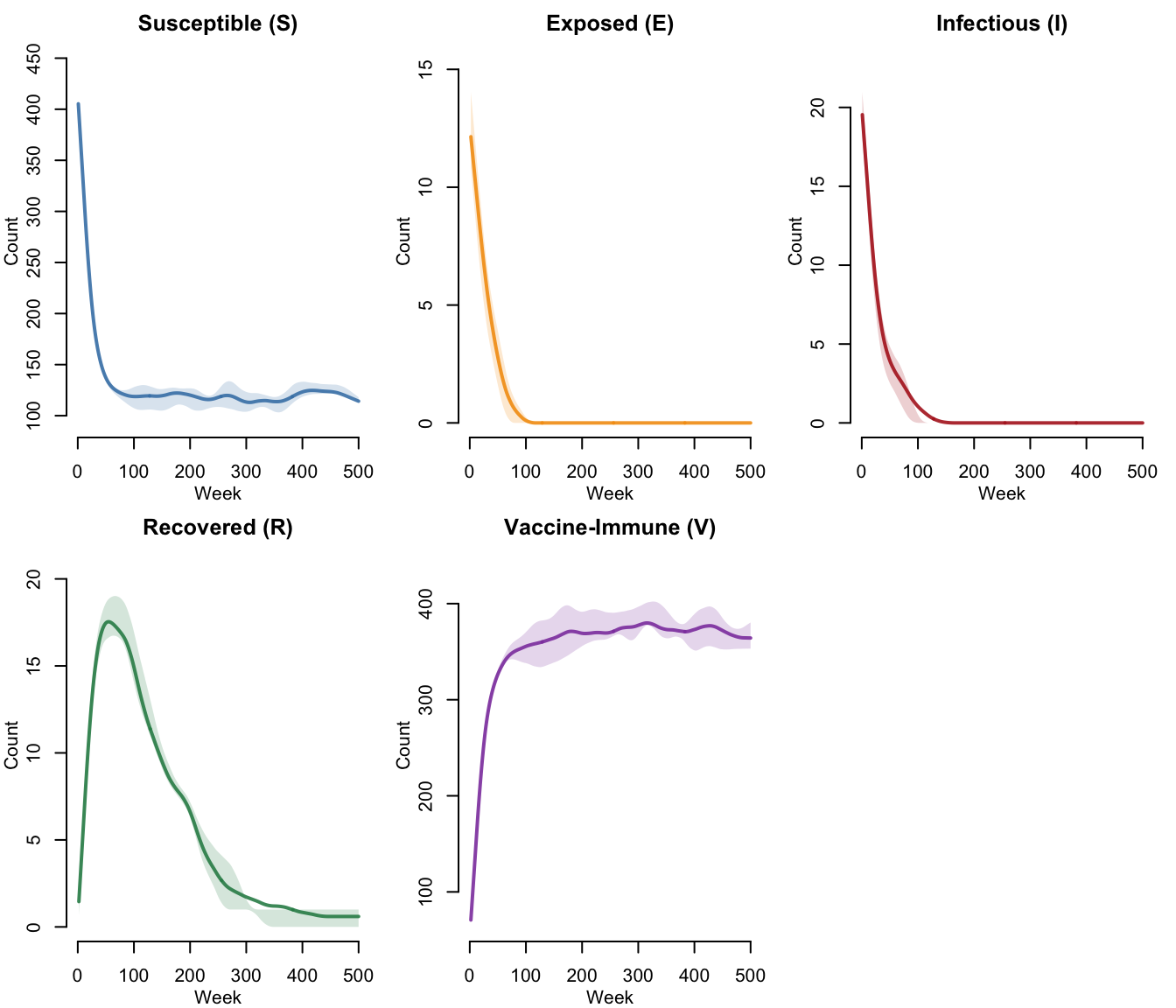
Vaccine Coverage Over Time
The vaccine-immune population grows over time as vaccination campaigns and newborn vaccination accumulate protected individuals. This plot shows the V compartment trajectory in isolation.
par(mar = c(3, 3, 2, 1), mgp = c(2, 1, 0))
plot(sim_vax, y = "v.num",
     main = "Vaccine-Immune Population Over Time",
     ylab = "Count (V)", xlab = "Week",
     mean.col = "#8e44ad", mean.lwd = 2, mean.smooth = TRUE,
     qnts.col = "#8e44ad", qnts.alpha = 0.2, qnts.smooth = TRUE,
     legend = FALSE)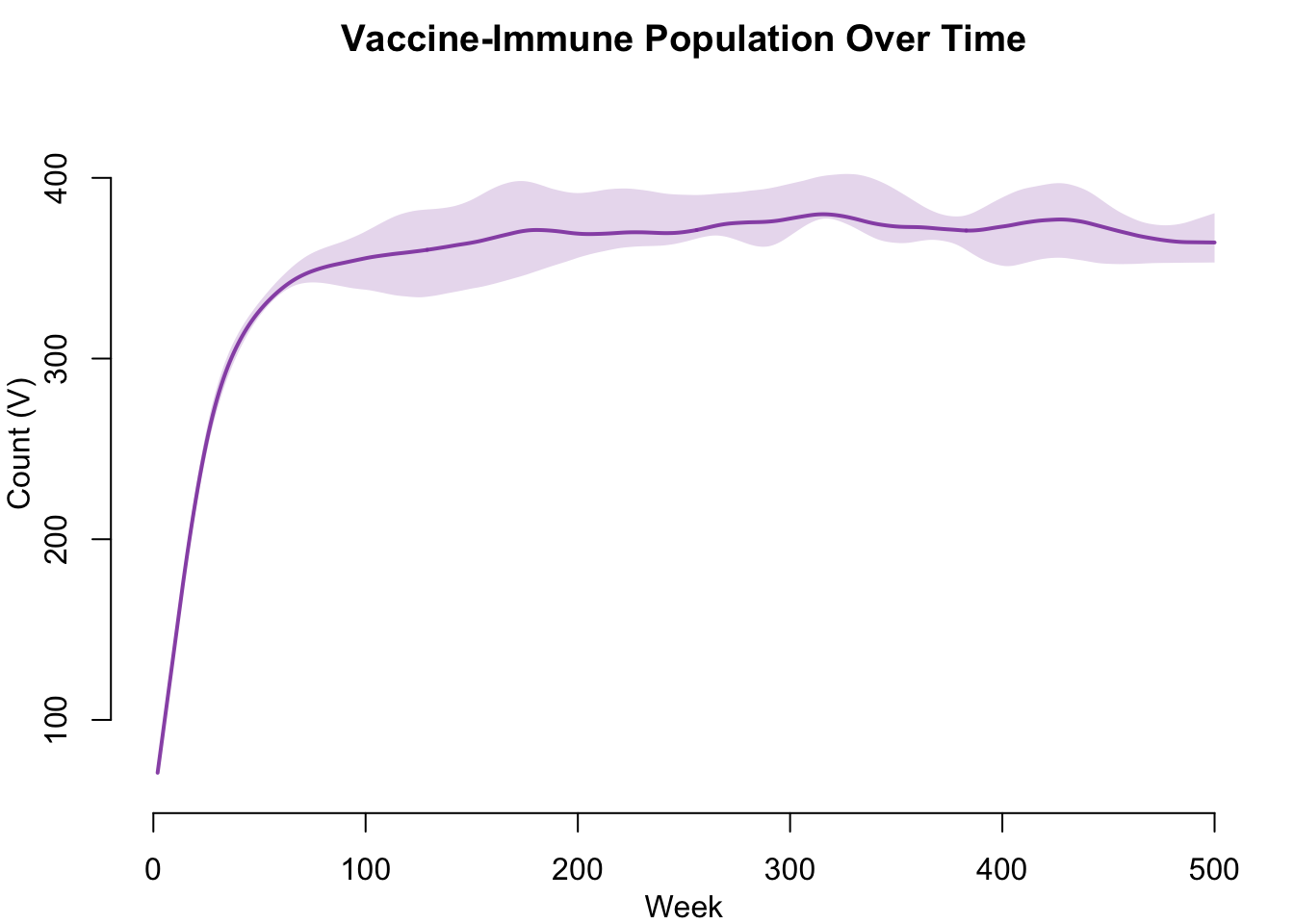
Incidence Comparison
New infections (S-to-E transitions) per week measure the force of infection. Vaccination reduces incidence by shrinking the susceptible pool available for transmission.
par(mar = c(3, 3, 2, 1), mgp = c(2, 1, 0))
plot(sim_novax, y = "se.flow",
     main = "New Infections per Week",
     ylab = "New Infections (S -> E)", xlab = "Week",
     mean.col = "firebrick", mean.lwd = 2, mean.smooth = TRUE,
     qnts.col = "firebrick", qnts.alpha = 0.2, qnts.smooth = TRUE,
     legend = FALSE, ylim = ylim_epi(list(sim_novax, sim_vax), "se.flow"))
plot(sim_vax, y = "se.flow",
     mean.col = "seagreen", mean.lwd = 2, mean.smooth = TRUE,
     qnts.col = "seagreen", qnts.alpha = 0.2, qnts.smooth = TRUE,
     legend = FALSE, add = TRUE)
legend("topright",
       legend = c("No Vaccination", "Strong AON Vaccination"),
       col = c("firebrick", "seagreen"), lwd = 2, bty = "n")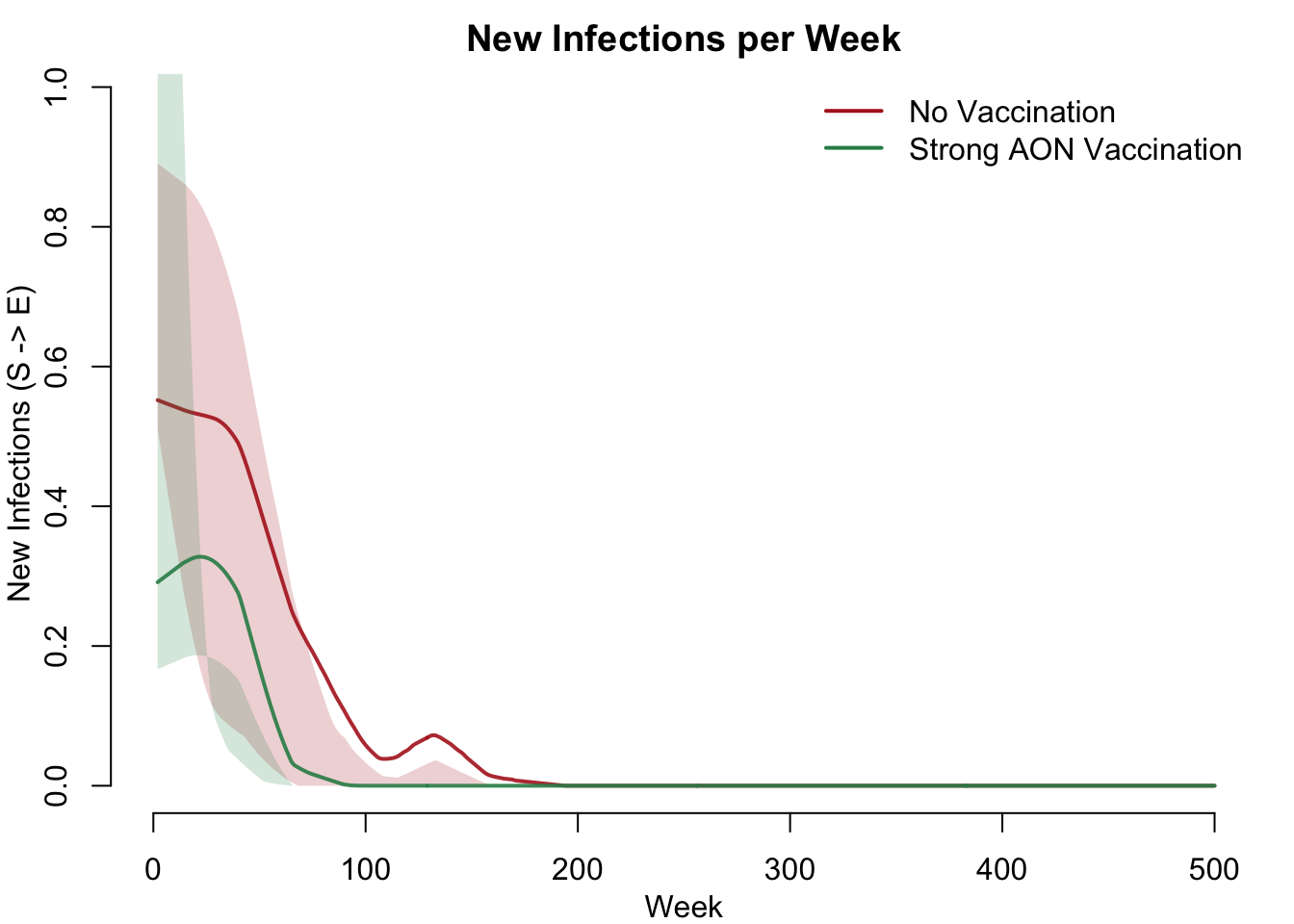
Summary Statistics
We extract simulation data and compute summary metrics over the final 20% of the simulation period to compare steady-state outcomes across scenarios.
df_novax <- as.data.frame(sim_novax)
df_vax <- as.data.frame(sim_vax)

late_novax <- df_novax$time > nsteps * 0.8
late_vax <- df_vax$time > nsteps * 0.8

data.frame(
  Metric = c("Mean prevalence",
             "Final prevalence",
             "Cumulative infections",
             "Mean population size",
             "Mean vaccine-immune (V)"),
  No_Vaccination = c(
    round(mean(df_novax$prev[late_novax], na.rm = TRUE), 3),
    round(mean(df_novax$prev[df_novax$time == max(df_novax$time)],
               na.rm = TRUE), 3),
    round(mean(tapply(df_novax$se.flow, df_novax$sim, sum, na.rm = TRUE))),
    round(mean(df_novax$num[late_novax], na.rm = TRUE)),
    0
  ),
  Strong_AON = c(
    round(mean(df_vax$prev[late_vax], na.rm = TRUE), 3),
    round(mean(df_vax$prev[df_vax$time == max(df_vax$time)],
               na.rm = TRUE), 3),
    round(mean(tapply(df_vax$se.flow, df_vax$sim, sum, na.rm = TRUE))),
    round(mean(df_vax$num[late_vax], na.rm = TRUE)),
    round(mean(df_vax$v.num[late_vax], na.rm = TRUE))
  )
)
Metric No_Vaccination Strong_AON
1 Mean prevalence 0 0
2 Final prevalence 0 0
3 Cumulative infections 52 15
4 Mean population size 505 476
5 Mean vaccine-immune (V) 0 357Parameters
Transmission Parameters
| Parameter | Description | Value |
|---|---|---|
inf.prob |
Per-act transmission probability | 0.5 |
act.rate |
Acts per partnership per week | 1 |
Disease Progression Parameters
| Parameter | Description | Value |
|---|---|---|
ei.rate |
E to I rate (mean latent period ~20 weeks) | 0.05 |
ir.rate |
I to R rate (mean infectious period ~20 weeks) | 0.05 |
Vital Dynamics Parameters
| Parameter | Description | Value |
|---|---|---|
departure.rate |
Baseline weekly mortality rate | 0.008 |
departure.disease.mult |
Mortality multiplier for infected | 2 |
arrival.rate |
Per-capita weekly birth rate | 0.008 |
Vaccination Parameters (All-or-Nothing)
| Parameter | Description | No Vax | Strong Vax |
|---|---|---|---|
vaccination.rate.initialization |
Initial population vaccination rate | 0 | 0.05 |
protection.rate.initialization |
Protection rate for initial vaccinees | 0 | 0.8 |
vaccination.rate.progression |
Weekly campaign vaccination rate | 0 | 0.05 |
protection.rate.progression |
Protection rate for campaign vaccinees | 0 | 0.8 |
vaccination.rate.arrivals |
Newborn vaccination rate | 0 | 0.6 |
protection.rate.arrivals |
Protection rate for vaccinated newborns | 0 | 0.8 |
Network Parameters
| Parameter | Description | Value |
|---|---|---|
| Population size | Number of nodes | 500 |
| Mean degree | Average concurrent partnerships | 0.8 |
| Partnership duration | Mean edge duration (weeks) | 50 |
Module Execution Order
The modules run in the following order at each timestep:
resim_nets -> initAttr -> departures -> arrivals -> infection -> progress -> prevalenceDepartures and arrivals are placed before infection so the network reflects the current population when transmission is simulated. The initAttr module only operates at the first timestep to set up vaccination attributes. The network is resimulated first because the population size may have changed from the prior timestep’s vital dynamics.
Next Steps
- Add waning vaccine immunity to convert V back to S, making vaccine protection temporary (SEIR-V with waning). This would require adding a
vs.rateparameter and logic in the progression module. - Compare with leaky vaccination — see SEIRS with Leaky Vaccination for the alternative vaccine model where protection reduces but does not eliminate transmission probability.
- Add booster doses by allowing re-vaccination of individuals whose protection has waned, extending the one-shot assumption to a multi-dose schedule.
- Implement age-targeted vaccination by combining with age attributes — see SI with Vital Dynamics for the age module pattern.
- Model vaccine hesitancy by making vaccination rates heterogeneous across individuals or network neighborhoods.
- Add cost-effectiveness analysis to evaluate the vaccination program’s economic efficiency — see Cost-Effectiveness Analysis for the cost and QALY tracking framework.