Left-truncates simulation epidemiological summary statistics and network statistics at a specified time step.
Usage
truncate_sim(x, at, reset.time)

# S3 method for class 'dcm'
truncate_sim(x, at, reset.time = TRUE)

# S3 method for class 'icm'
truncate_sim(x, at, reset.time = TRUE)

# S3 method for class 'netsim'
truncate_sim(x, at, reset.time = TRUE)Details
This function would be used when running a follow-up simulation from time
steps b to c after a burn-in period from time a to
b, where the final time window of interest for data analysis is
b to c only.
For icm and netsim objects, at is a time step as labeled by
as.data.frame.icm(). With reset.time = FALSE, the time step of the first
row kept is stored in control$epi.start, from which as.data.frame.icm(),
the plot and summary methods, and comp_plot() label the time steps.
Without it, the rows are labeled from 1, as in the output of icm() and
netsim(), including restarted simulations.
For netsim objects, the network statistics are truncated along with the
epi trackers, as both hold one row per time step. With reset.time = TRUE,
the times of the attribute history, the raw records, the transmission
matrix, and the cumulative edgelist are shifted to the new time steps as
well, so that get_attr_at(), get_transmat() and make_networkDynamic()
read them in the same frame. Their records before at are kept, with times
of 0 or less, as the state of the nodes and edges at at depends on them
and the transmissions before at remain part of the transmission chains.
The saved networks and the run sublists, which hold the state needed to
restart a simulation, keep their original time steps. Build a restart point
with make_restart_point() from the object before truncating it.
Examples
# DCM examples
param <- param.dcm(inf.prob = 0.2, act.rate = 0.25)
init <- init.dcm(s.num = 500, i.num = 1)
control <- control.dcm(type = "SI", nsteps = 200)
mod1 <- dcm(param, init, control)
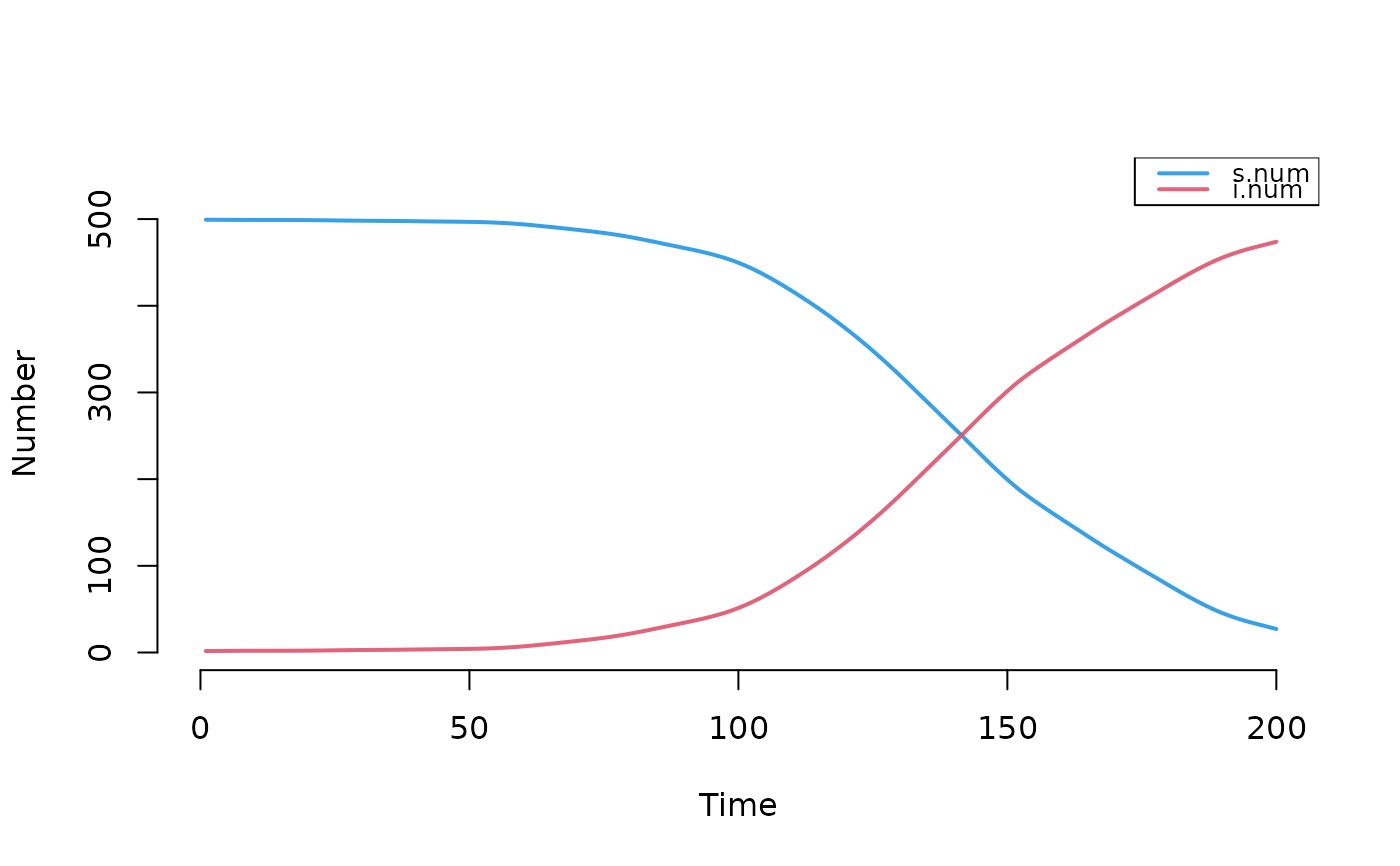
plot(mod1)
 # Reset time
mod2a <- truncate_sim(mod1, at = 150)
plot(mod2a)
# Reset time
mod2a <- truncate_sim(mod1, at = 150)
plot(mod2a)
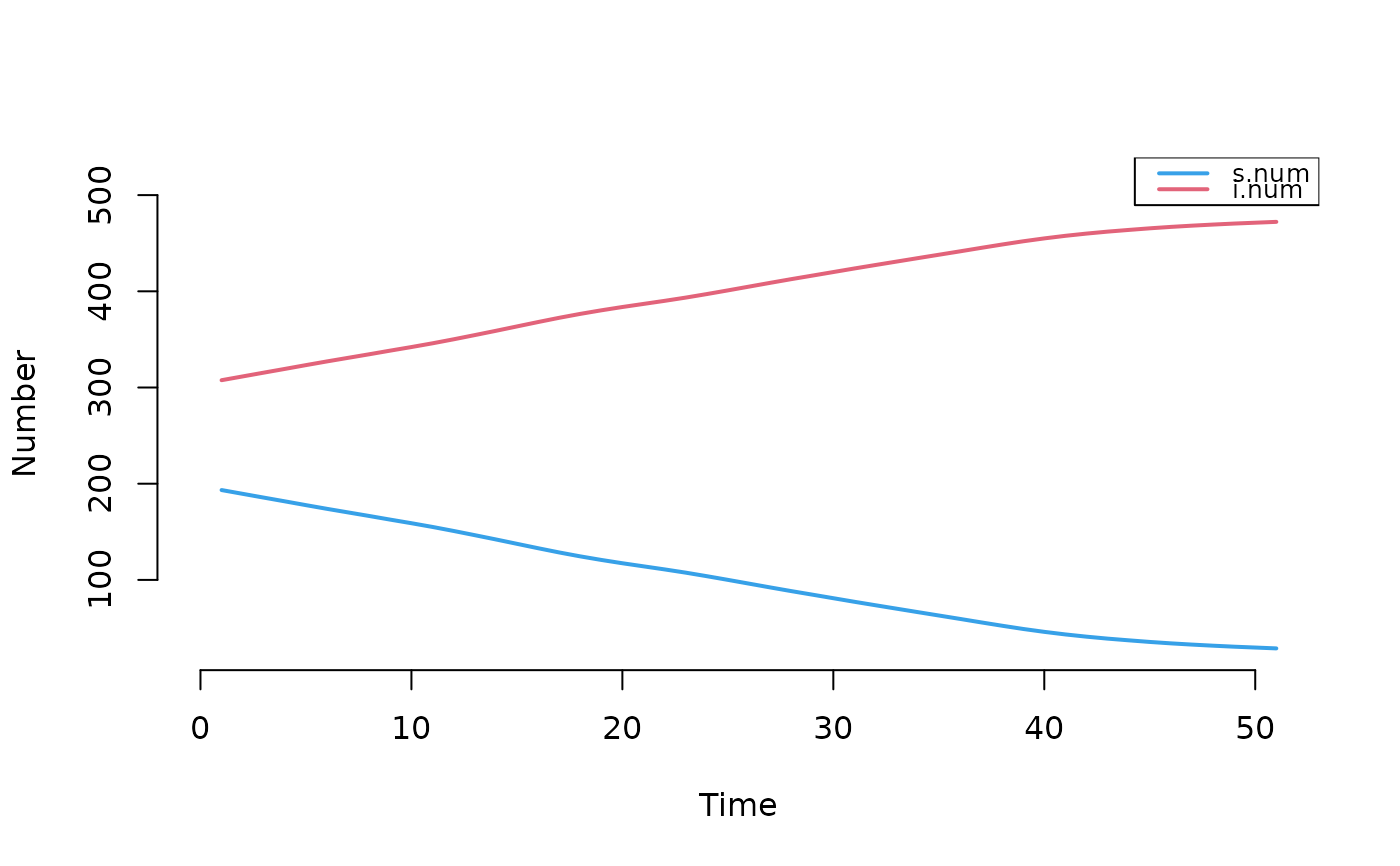 head(as.data.frame(mod2a))
#> time s.num i.num si.flow num
#> 1 1 112.84477 388.1552 4.311259 501
#> 2 2 108.53351 392.4665 4.190824 501
#> 3 3 104.34268 396.6573 4.070347 501
#> 4 4 100.27233 400.7277 3.950123 501
#> 5 5 96.32221 404.6778 3.830429 501
#> 6 6 92.49178 408.5082 3.711522 501
# Do not reset time
mod2b <- truncate_sim(mod1, at = 150, reset.time = FALSE)
plot(mod2b)
head(as.data.frame(mod2a))
#> time s.num i.num si.flow num
#> 1 1 112.84477 388.1552 4.311259 501
#> 2 2 108.53351 392.4665 4.190824 501
#> 3 3 104.34268 396.6573 4.070347 501
#> 4 4 100.27233 400.7277 3.950123 501
#> 5 5 96.32221 404.6778 3.830429 501
#> 6 6 92.49178 408.5082 3.711522 501
# Do not reset time
mod2b <- truncate_sim(mod1, at = 150, reset.time = FALSE)
plot(mod2b)
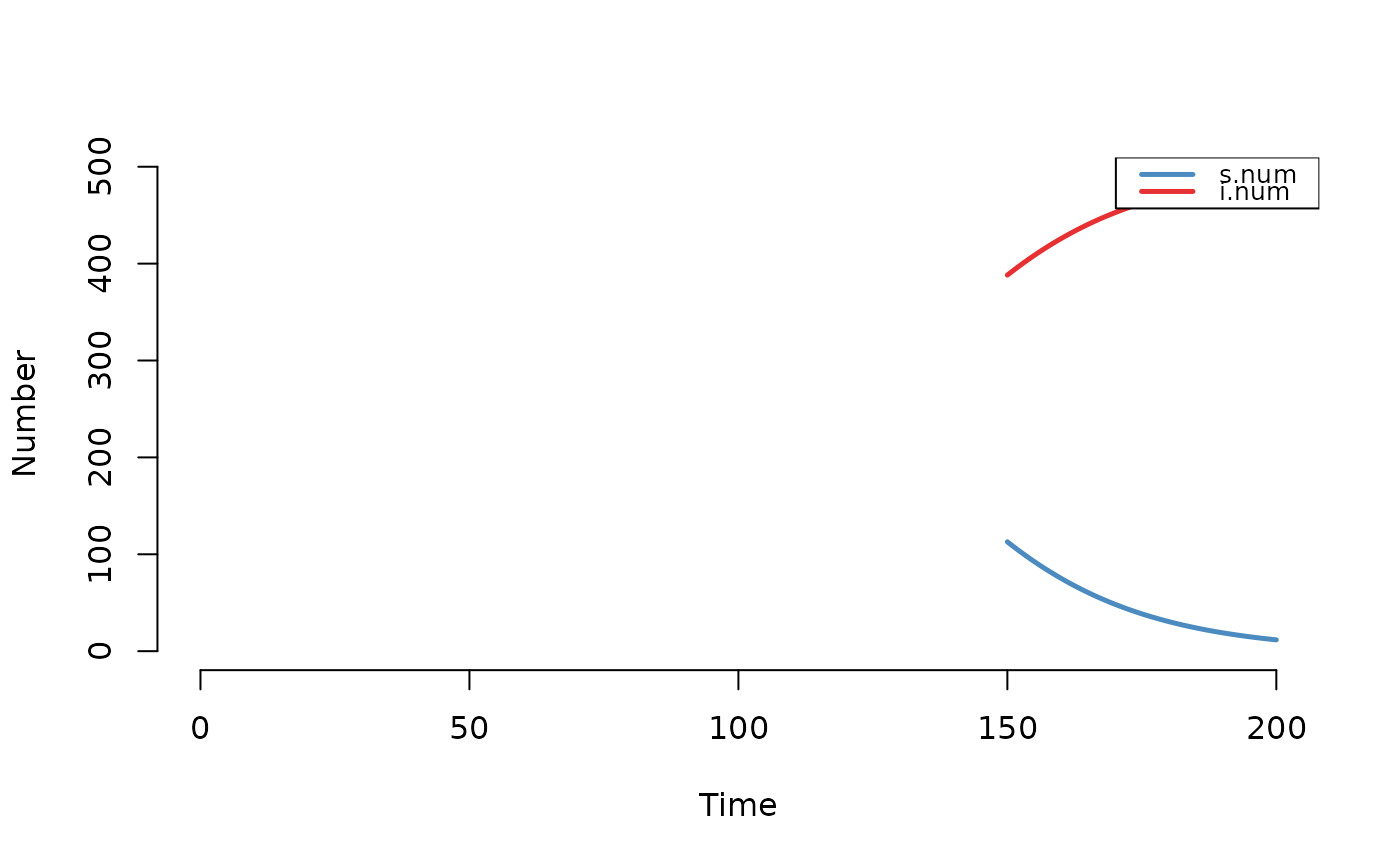 head(as.data.frame(mod2b))
#> time s.num i.num si.flow num
#> 1 150 112.84477 388.1552 4.311259 501
#> 2 151 108.53351 392.4665 4.190824 501
#> 3 152 104.34268 396.6573 4.070347 501
#> 4 153 100.27233 400.7277 3.950123 501
#> 5 154 96.32221 404.6778 3.830429 501
#> 6 155 92.49178 408.5082 3.711522 501
# \donttest{
# ICM example
param <- param.icm(inf.prob = 0.2, act.rate = 0.25)
init <- init.icm(s.num = 500, i.num = 1)
control <- control.icm(type = "SI", nsteps = 200, nsims = 1)
mod1 <- icm(param, init, control)
# Reset time
mod2a <- truncate_sim(mod1, at = 150)
plot(mod2a)
head(as.data.frame(mod2b))
#> time s.num i.num si.flow num
#> 1 150 112.84477 388.1552 4.311259 501
#> 2 151 108.53351 392.4665 4.190824 501
#> 3 152 104.34268 396.6573 4.070347 501
#> 4 153 100.27233 400.7277 3.950123 501
#> 5 154 96.32221 404.6778 3.830429 501
#> 6 155 92.49178 408.5082 3.711522 501
# \donttest{
# ICM example
param <- param.icm(inf.prob = 0.2, act.rate = 0.25)
init <- init.icm(s.num = 500, i.num = 1)
control <- control.icm(type = "SI", nsteps = 200, nsims = 1)
mod1 <- icm(param, init, control)
# Reset time
mod2a <- truncate_sim(mod1, at = 150)
plot(mod2a)
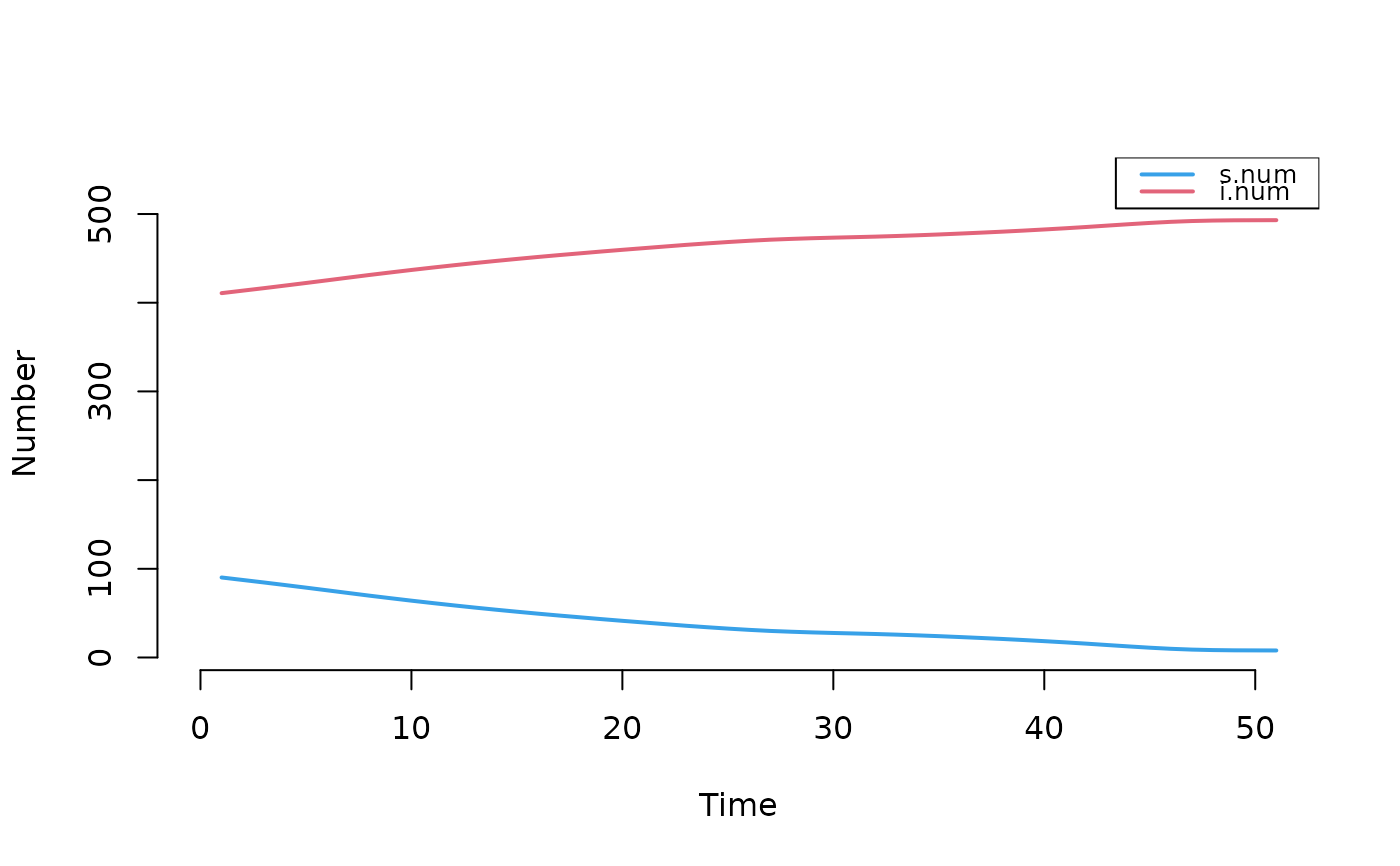 head(as.data.frame(mod2a))
#> sim time s.num i.num num si.flow
#> 1 1 1 473 28 501 1
#> 2 1 2 471 30 501 2
#> 3 1 3 471 30 501 0
#> 4 1 4 470 31 501 1
#> 5 1 5 468 33 501 2
#> 6 1 6 466 35 501 2
# Do not reset time
mod2b <- truncate_sim(mod1, at = 150, reset.time = FALSE)
plot(mod2b)
head(as.data.frame(mod2a))
#> sim time s.num i.num num si.flow
#> 1 1 1 473 28 501 1
#> 2 1 2 471 30 501 2
#> 3 1 3 471 30 501 0
#> 4 1 4 470 31 501 1
#> 5 1 5 468 33 501 2
#> 6 1 6 466 35 501 2
# Do not reset time
mod2b <- truncate_sim(mod1, at = 150, reset.time = FALSE)
plot(mod2b)
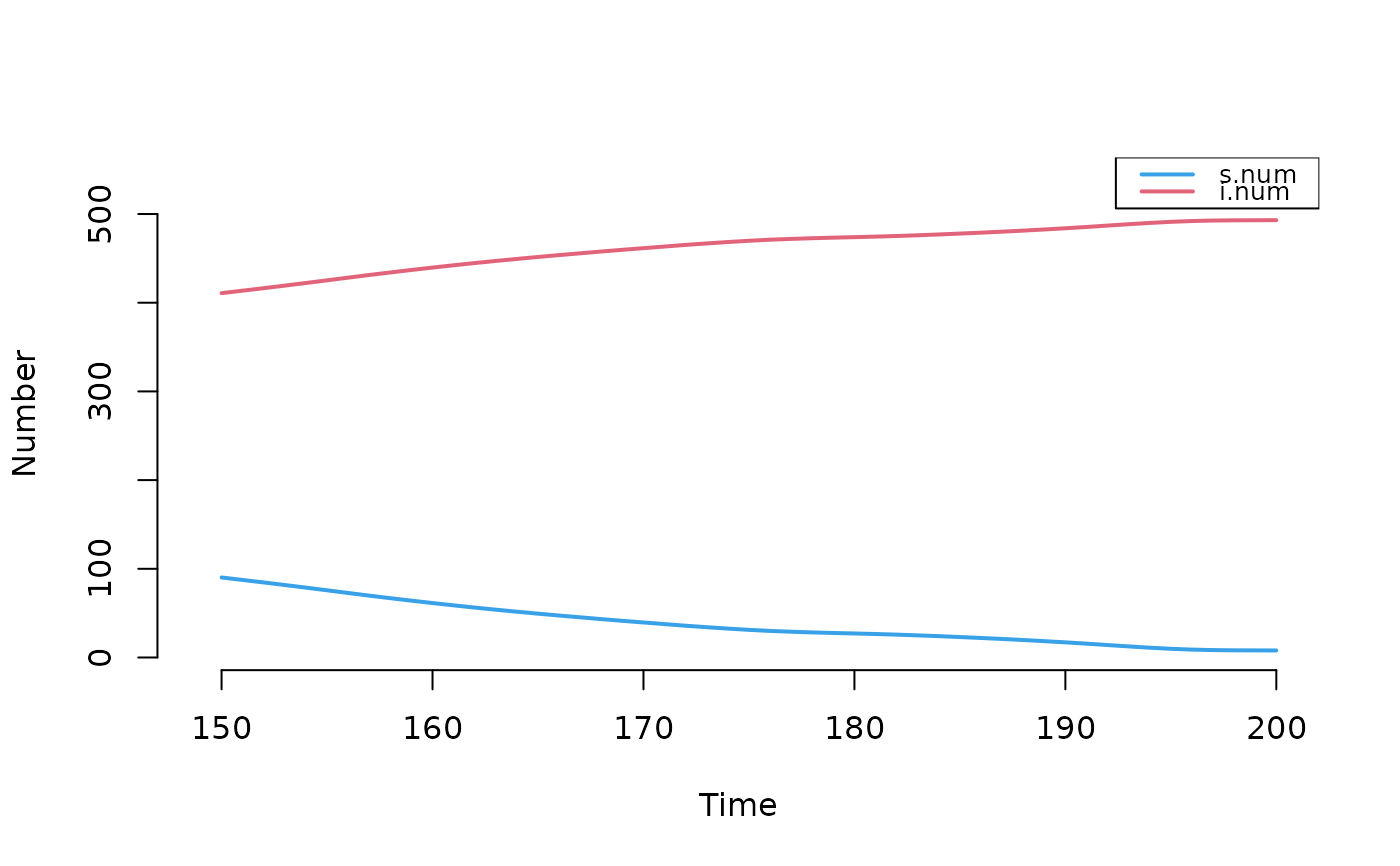 head(as.data.frame(mod2b))
#> sim time s.num i.num num si.flow
#> 1 1 150 473 28 501 1
#> 2 1 151 471 30 501 2
#> 3 1 152 471 30 501 0
#> 4 1 153 470 31 501 1
#> 5 1 154 468 33 501 2
#> 6 1 155 466 35 501 2
# }
head(as.data.frame(mod2b))
#> sim time s.num i.num num si.flow
#> 1 1 150 473 28 501 1
#> 2 1 151 471 30 501 2
#> 3 1 152 471 30 501 0
#> 4 1 153 470 31 501 1
#> 5 1 154 468 33 501 2
#> 6 1 155 466 35 501 2
# }